Bangladesh: The Impact Nation
By Adnan Dewan · Sep 22, 2026, 5:30 PM
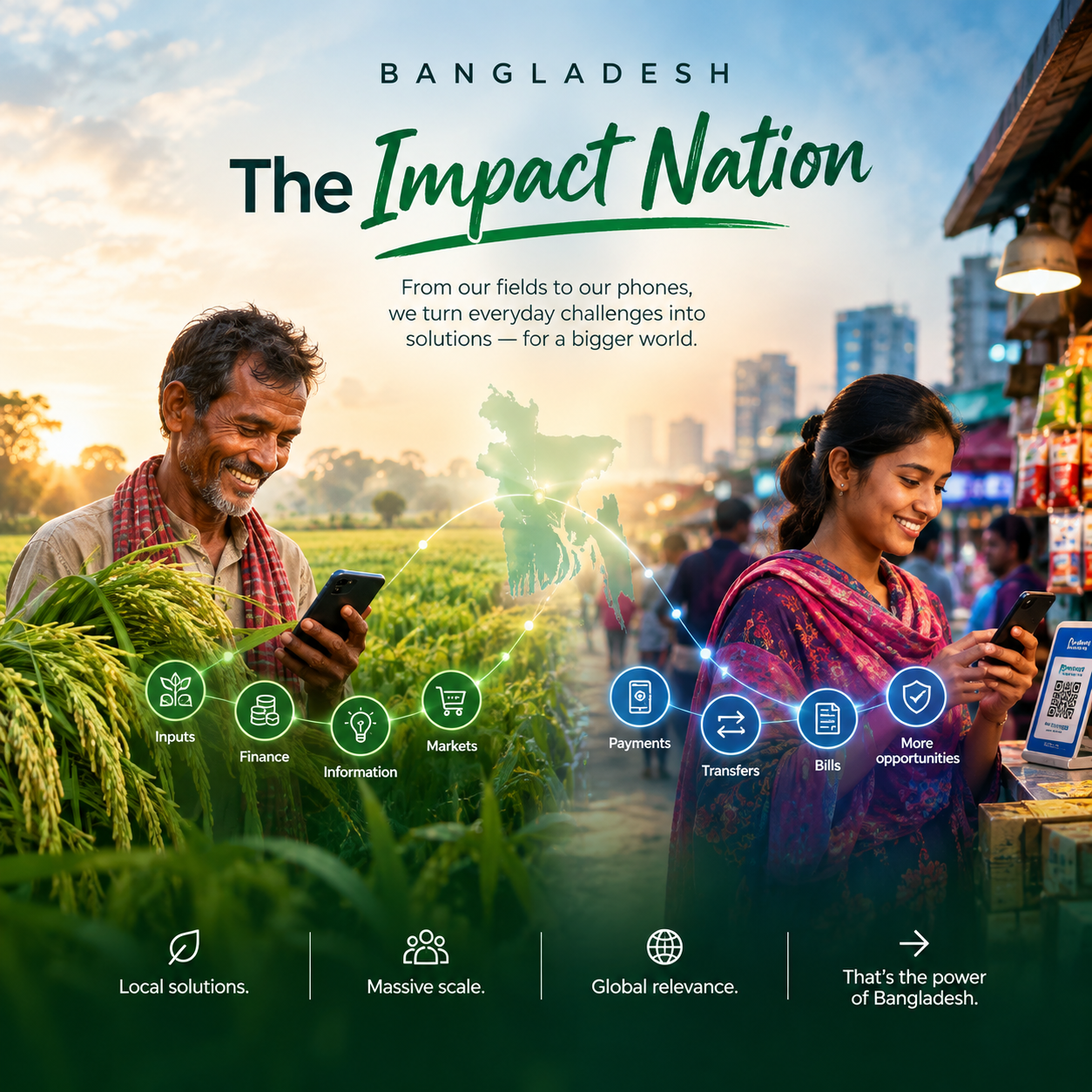
Imagine a farmer standing in a field, waiting for the right season to begin. He needs money for inputs, advice on what to grow, and eventually a reliable buyer. For decades, these were separate problems: finance in one place, knowledge somewhere else, and the market somewhere far away.
Now imagine putting all three within reach of that farmer through technology, data, and a network of local partners. That is the kind of innovation emerging from Bangladesh's agricultural ecosystem today: not simply giving farmers technology, but connecting capital, knowledge, inputs, and markets around the person who needs them.
Now move from the field to a crowded neighborhood in Dhaka. Someone needs to send money to their mother in a village. Another person needs to pay a bill. A small shopkeeper needs to receive a payment. None of them wants to understand the financial system's architecture. They need money to move.
So technology turned the mobile phone into a financial doorway. Today, Bangladesh has built one of the world's largest mobile financial services markets, with services reaching deep into everyday life.
These two stories look completely different. One begins with a farmer and a field. The other begins with a phone and a few hundred taka. But underneath, they are solving the same problem:** How do you bring opportunity closer to people who are far away from the systems that create it?**
And that may be one of Bangladesh's most interesting capabilities. We are often forced to solve problems where resources are limited, populations are enormous, infrastructure is uneven, and the last mile is very real. So our solutions cannot remain inside boardrooms. They have to survive in villages, markets, streets, and homes. That creates something unexpected.
Our problems may actually be our innovation laboratories.
A financial system built for millions of people outside traditional banking. An agricultural platform connecting small farmers with finance and markets. A climate solution designed around people living beside rivers. A healthcare model that reaches people before they reach a hospital. The common thread is not technology.
It is access at scale.
And perhaps this is where Bangladesh can begin to think differently about its place in the world. For decades, we have thought about development as something that comes to Bangladesh: capital, technology, expertise, and solutions arriving from elsewhere.
But what if the direction can change? What if Bangladesh can take the problems we have learned to solve, turn them into scalable solutions, and take those solutions to other parts of the world facing similar challenges?
Not only garments. Not only software. Solutions.
Maybe the next great thing Bangladesh exports will not be something manufactured in a factory. Maybe it will be something developed through decades of living with complexity.
The ability to turn constraints into solutions, and solutions into impact at scale. That is the idea of an Impact Nation.
Not a country without problems. A country that learns how to solve them, and then helps the world solve its own.
Sources
- Personal thoughts and experience and also dream
About the writer

Adnan brings 12+ years of work across startups, innovation programs, and young founder development in Bangladesh. He is working with Startup Bangladesh Limited and has worked with the iDEA project, guiding startups and helping run national ecosystem programs such as Student to Startup.
Knowledge layer
Connected notes
Add evidence, a correction, or useful context. STS reviews every note before it appears; this is not a comment thread.
Loading notes…